
On Saturday, February 22nd, percussionist Sunny Jain brings his Wild Wild East project to The Dennis C. Moss Cultural Arts Center in Cutler Bay. I’ve been following Jain’s career and listening to his music for nearly 20 years, since some of his first recordings for Zoho Records, which I consider to be groundbreaking work in South Asian jazz. For my forthcoming book I’ve been talking to many of Jain’s collaborators and his music has come up often in those conversations. This upcoming show presented a convenient moment for finally talking with Jain himself. And I’m grateful to Sunny for taking the time to talk. Part of our conversation — along with more information on the Wild Wild East project and ticket info for Saturday’s show — is below. (MJL)
First, for those who have never heard Jain’s Wild Wild East project, check out his Tiny Desk Concert…!
This project was recorded on an album by the same name released in 2020. It’s hard for me to pick a favorite track, but here’s one that’s not included in the Tiny Desk concert…!
On Jain’s website, Wild Wild East is described with much of the vibrancy and thoughtfulness that I’ve come to appreciate from all of his music:
“Wild Wild East casts its nets just as wide, but what it hauls in can’t be defined by any single point. This isn’t a jazz record, though it’s impossible to imagine without jazz; nor is it a South Asian party record, though Jain’s persistent dhol playing is impossible to resist. He brings us out to the wide-open spaces of the American West, a different kind of Indian engaging with the tired old cowboy. The cresting hum of Morricone can still be heard, but Jain also reminds us that R.D. Burman’s Bollywood compositions were born in the same kind of heat.”
Aside from his expert musicianship (in performance, composition, and bandleading), Jain’s gift for joyful, evocative, and sometimes raucous (or…ebullient?) storytelling sets him apart from his peers in both the jazz and “world music” scenes. I should not have been surprised that our conversation unfolded in similar ways. Here’s an edited excerpt from my recent interview with Jain in which he discusses the joys of sharing his story with audiences around the country through music.
The Rhythm of Study / Mark Lomanno (TRoS): A lot of what we’ve been talking about is related to the Wild Wild East Project. And I want to ask you about performing in Florida. I think this relates both to your Love Force project and to Wild Wild East. The spirit of Wild Wild East is a critical look at American identity while celebrating the immigrant and refugee experience. This comes through in Red Baraat and through a lot of your work: this idea of inclusivity, pluralism, and collective joy. And empathy and tolerance. These are all things that have been politicized lately. You’ve spoken about this in the past and whether you consider your music as political or not. I wonder: have you given any thought to bringing your music here?
Sunny Jain (SJ): I haven’t given it specific thought. I’d say on a general note, you know, in early December I was doing a bunch of residency programs out in the Quad Cities area, which is this collection of cities out in Iowa and Illinois. Interestingly enough when I was out there I found out that’s where Louis Bellson and Bix Beiderbecke are from. [Bellson is from Rock Falls, Illinois, and Beiderbecke from Davenport, Iowa. -MJL] I had no idea. I thought that was kind of cool and I was excited to go there. So, in the early years of Red Baraat, we used to tour all over the States. And we used to just have these interesting experiences because, you know, it was a motley crew of eight folks going around: unfortunately mostly male, but African-American, white, Indian, Sikh guy wearing a turban, Asian guy. You know, we’re an interesting bunch. And wherever you are in the Midwest — or even in the South, or wherever you are in the States if you’re not in a big metropolis area — you walk in a bar or restaurant and people are like, “Who are these guys? What’s going on?” I used to enjoy the work after the show — “the work” meaning just going to a bar, going to restaurant, hanging out, and meeting people.
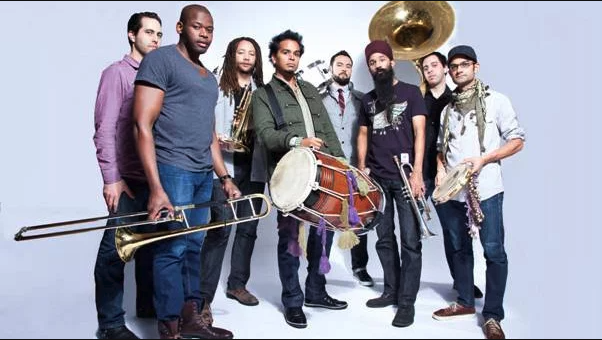
So I hadn’t done that in some time, largely because of the pandemic; and then I decided to shift my purpose in life, with just chilling out and touring some. So I was very excited to go to this area in the Quad Cities. I went with the trio — just my bass player and the saxophone player from Wild Wild East — to do these educational shows. And I was very curious to see who we were gonna encounter, what’s gonna happen. I just met so many — it was largely white; I’d say 95% white — but everyone was lovely. Everyone was extremely sweet. And in our educational programs and some performances — and what I’ll be doing in Miami — what I do with this band is that I talk from my experience. I told my story. And that’s all I can really do. And I think the idea is being able to have that platform, to showcase a group that is varied, and to talk about my experience of what happened to my family. How deep I get into it and how much I don’t depend on the audience and the venue I’m playing. But, by and large, I talk about the idea of migration and immigration, and when my parents came to this country. There are little vignettes to lead into a song: my family came here, and then my family moved over here, and then they arrived here in America.
I told my story. And that’s all I can really do…being able to have that platform, to showcase a group that’s varied, and to talk about my experience.
Sunny Jain, on the power of sharing stories
And it’s this immigrant experience. I think, when you’re sharing that, I can trust that people reflect on their own, on what it means to them: what is their experience? what is their family story? And so, I’m thankful; and actually, I probably feel more emboldened to travel around the States and tour more because of what’s happening politically. To be visible. To make sure we’re meeting people because, yeah, on a macro level, it feels helpless. I won’t succumb to that. I would just feel like I can’t do anything. I’m going to do what I need to do. But I also know my efforts on a micro level of impacting my immediate community, my family, my kids first and foremost. My kids, my family, my block, you know, my neighborhood, my family in Philly and Jersey. Whoever I can impact in that manner. That’s “the work.” And that extends, also, with touring — being able to get on those stages, being able to meet people, being able to talk to people, being able to share little storylines about what these songs are about, or what this show’s about, and let them extrapolate and let them reflect on it in their own in their own manner. So that’s generally how I feel about coming to Florida. First of all, I do love that Miami weather. [laughs] I mean, I’m excited to come to Miami, you know?
TRoS: Yeah, it’s really nice here. Yeah. And it will be a good time to come, too.
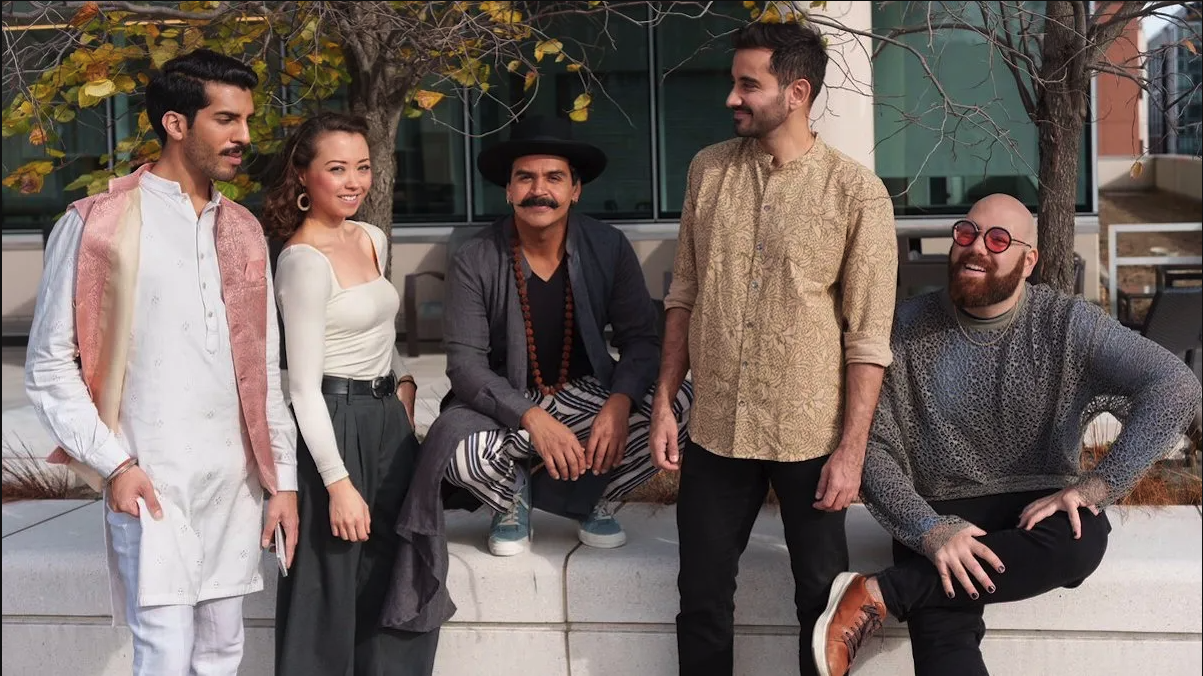
SJ: Nice. I’m looking forward to it. And I’ve played down at this spot before. Eric Fliss who runs it has brought Red Baraat there before. I think twice. So he heard about the Wild Wild East band and wanted to bring us down there as well. And I think it’s being sponsored by an Indian organization [The Miami Association of Indian Americans for Culture and Arts -MJL] as well. So I’m hoping, you know, it’s reaching that community as well and those folks come out. So, yeah, politically in light of all that, I’m gonna do what I do. And be pleased to meet people, and be given this opportunity to do so.
TRoS: I really appreciate you saying that. In thinking about “what I could do?”, that comment about, you know, distinguishing the local level from the macro level, that’s a really important part of the work to be done moving forward. We may not be able to conceive of or envision the large-scale structural change that I think a lot of people can identify as needing to happen, but the idea of starting with your home, with your family, with your local community, and building out from there really resonates with me.
For more event information, including ticket sales, visit the Moss Center website. For more information on Sunny Jain, visit his website at this link, where you’ll find his complete discography and a list of his current projects. (I’m personally diving deep into Phoenix Rise at present.) I also highly recommend the short documentary “Homecoming,” which chronicles Jain’s trip back to his ancestral homeland of Sialkot, Pakistan, to connect with his roots and the musicians who continue the traditions he incorporates into his music.
 The Rhythm of Study